
Last updated: November 11, 2026 · By Heather Shorr
From sensory-friendly museum mornings and inclusive gyms to animals, art, tennis and an aquarium night designed specifically for families with autism, these are LA experiences worth knowing about.
Finding something fun to do with your kids in Los Angeles is usually not difficult.
Finding something fun where you have a reasonable idea of what the noise will be like, whether the crowds will be manageable, whether your child can move around, and what happens if they become overwhelmed is a different story.
For families with autistic children, those details can completely change an outing.
A museum that is wonderful for one child might be exhausting for another. One autistic child may happily spend three hours watching jellyfish at an aquarium. Another might last 10 minutes because the crowd, echoes and changing lights are too much. One child may love a sensory gym filled with swings and climbing equipment. Another may be looking for exactly the opposite experience.
That’s why we aren’t really comfortable calling these the “10 best” activities for autistic children.
There is no universal best.
Instead, we looked for Los Angeles places and programs doing something meaningful to make their experiences more welcoming to autistic children, neurodivergent kids and families with sensory needs.
Some have dedicated sensory-friendly hours. Some offer headphones, fidgets, sensory maps or quiet spaces. A few were specifically created around autistic and neurodivergent children.
For each one, we’ve also included something that often gets left out of these lists:
What might be challenging?
Because knowing that before you leave home can be every bit as valuable as knowing what a place does well.
Quick Picks
- Place to start if you're nervous about taking your child somewhere new: We Rock the Spectrum Kid's Gym
- Thoughtfully designed sensory-friendly museum experience: Noah's Ark at the Skirball
- For kids who want to touch everything: Discovery Cube Los Angeles
- Major LA attraction for families who want sensory tools available throughout a regular visit: Los Angeles Zoo
- Special event for families who want to experience a major attraction together: Aquarium of the Pacific
- For dinosaur-loving kids who benefit from planning ahead: Natural History Museum of Los Angeles County
- For an autistic child who loves art, color, patterns or unusual visual experiences: The Broad
- For trying an actual sport in an autism-focused environment: ACEing Autism
- For the child who wants to see a movie but can't comfortably sit through a traditional theater experience: Regal My Way Matinee
- Free option, and sometimes genuinely the best option on this entire list: A Quiet Morning at the Park
1. We Rock the Spectrum Kid’s Gym – Tarzana
Best place to start if you’re nervous about taking your child somewhere new
If you’ve ever left a children’s play place because you felt like everyone was watching your child, We Rock the Spectrum is worth knowing about.
The original We Rock the Spectrum gym is in Tarzana, and the entire concept was built around providing a sensory-safe place where children of all abilities can play together.
That makes it fundamentally different from putting a sensory-friendly label on an otherwise conventional attraction.
The equipment itself is designed with sensory needs in mind. Depending on the setup and session, children can encounter swings, climbing structures, trampolines, crash pads and other equipment providing opportunities for movement and sensory input. There are also quieter areas and activities for children who need something different.
Most importantly, autistic children aren’t an unusual visitor here.
They’re part of the reason the place exists.
That can make an enormous difference for parents too.
You don’t have to spend the entire visit worrying that your child’s behavior is disrupting someone else’s version of how children are supposed to play.
- Location: 5520 Crebs Avenue, Tarzana, CA 91356
- Best for: Kids who enjoy movement, swinging, climbing, jumping and sensory play.
- Age range: The gym welcomes children across a broad range of ages and abilities. We’d call ahead if you’re bringing an older child and want to make sure the current open-play environment will be a good fit.
- Sensory accommodations: The entire environment is designed around sensory-friendly and inclusive play rather than having sensory accommodations added as an afterthought.
- Noise level: Variable. This is still a children’s gym. Kids will be playing, moving and making noise.
- Crowds: Open play can vary considerably. Call before going if crowd level is particularly important for your child.
- Quiet/calming space: The gym’s design includes areas and equipment intended to support different sensory needs.
- Bathrooms: Available on site.
- Parking: Much easier than a downtown museum outing. It’s in a commercial area of Tarzana rather than a giant attraction complex.
- Food: Think of this as a play session rather than a half-day destination. Ventura Boulevard and the surrounding Tarzana area have plenty of food options before or afterward.
- What might be challenging: A child who is sensitive to other children running, vocalizing or moving unpredictably could still find a busy open-play session overwhelming.
- Before you go: Call or check the gym’s social media for current open-play hours. The Tarzana location specifically advises families to verify its schedule because hours can change.
- Website: https://www.werockthespectrumkidsgym.com/
Why we’d recommend it: There is something reassuring about going somewhere where you don’t have to explain why your child needs what they need.
2. Noah’s Ark at the Skirball – Sensory Friendly Fridays
Best thoughtfully designed sensory-friendly museum experience
Noah’s Ark is already one of the more unusual children’s experiences in Los Angeles.
The giant interactive installation at the Skirball Cultural Center is filled with animals constructed from recycled and everyday materials. Children can climb, build, make music, create storms, interact with the animals and explore the enormous ark.
It’s imaginative and tactile.
It can also involve a lot of sensory input.
That’s what makes the Skirball’s Sensory Friendly Fridays particularly valuable.
These sessions are specifically designed for guests with autism spectrum disorders, sensory-processing differences and other developmental disabilities. The Skirball reduces the number of visitors in Noah’s Ark, quiets the galleries and relaxes its music and story programming.
Families can also borrow noise-dampening headphones, sensory bags and lanterns for children who have difficulty with low-light areas.
As of September 2026, Sensory Friendly Fridays resume September 11 and are scheduled on Fridays from noon to 1:30 p.m., with some excluded dates later in the year. Reservations are recommended.
- Location: 2701 N. Sepulveda Boulevard, Los Angeles, CA 90049
- Best for: Children who enjoy imaginative play, animals, tactile exploration, building and interactive environments.
- Sensory-friendly time: Fridays, 12:00 to 1:30 p.m. beginning September 11, 2026, except selected dates.
- Crowds: Reduced during the sensory-friendly session.
- Noise: Quieter than the standard Noah’s Ark experience during Sensory Friendly Fridays.
- Available sensory tools: Noise-dampening headphones, sensory bags and lanterns for low-light sensitivity.
- Length: The sensory-friendly reservation is a 90-minute time slot, which is actually a nice amount of time for this experience.
- Current admission: Approximately $15 to $20 depending on ticket type, with members and children under 2 free. Check current pricing when reserving.
- Parking: The Skirball has on-site parking, one of the underrated advantages of taking kids somewhere in Los Angeles.
- Food: Food options and other museum amenities vary, so check what’s open on the day you’re visiting.
- What might be challenging: Noah’s Ark is interactive by design. Even with fewer people and reduced sound, there is movement, tactile stimulation and other children actively playing around the space.
- Website: https://www.skirball.org/programs/sensory-friendly-fridays
Our parent tip: If predictability helps your child, show them photos or videos of Noah’s Ark before you go. It’s a visually unusual environment, and knowing what the giant animals and interior look like may make arrival easier.
3. Discovery Cube Los Angeles – Sensory Friendly Mornings
Best for kids who want to touch everything
Traditional museums can be difficult when your child wants to interact with everything they see.
Discovery Cube is built around doing exactly that.
The Sylmar science museum has dozens of interactive exhibits where kids can experiment, move things, solve problems and explore science through hands-on activities.
Even better, Discovery Cube Los Angeles currently holds Sensory Friendly Mornings on the third Sunday of every month from 8:00 to 10:00 a.m.
That’s before the museum opens to the general public.
Families get the benefit of a quieter, less crowded environment for the first two hours and can stay after 10 a.m. when regular admission begins.
That last part is useful. If your child is doing great, you don’t suddenly have to leave because the sensory session has ended.
- Location: 11800 Foothill Boulevard, Sylmar, CA 91342
- Best for: Curious kids, hands-on learners and children who like cause-and-effect activities.
- Sensory-friendly time: Third Sunday of each month, 8:00 to 10:00 a.m.
- Regular hours: Generally 10:00 a.m. to 5:00 p.m., with selected closure dates.
- Sensory-friendly admission: Included with regular admission or membership.
- Crowds: Significantly more manageable during the special morning than we’d expect during a busy weekend afternoon.
- Noise: Reduced during the sensory-friendly session, although this remains an interactive children’s science museum.
- Bathrooms: Yes.
- Parking: On-site parking makes this a relatively straightforward outing compared with many central LA attractions.
- Food: Check current museum dining options before visiting, or plan to eat nearby.
- What might be challenging: Some interactive exhibits inherently produce noise, movement or visual stimulation. The sensory-friendly morning improves the environment, but it doesn’t turn Discovery Cube into a silent museum.
- Website: https://www.discoverycube.org/sensory-friendly-mornings/
Our parent tip: Go at 8:00. Those two hours before general opening are the reason this makes our list. If things are still going well at 10:00, stay. If the environment changes too much once regular visitors arrive, you’ve already had a full two-hour experience.
4. Los Angeles Zoo
Best major LA attraction for families who want sensory tools available throughout a regular visit
The LA Zoo is a good example of a mainstream attraction making a serious effort to become more accessible to people with sensory needs.
The Zoo is certified as sensory inclusive through KultureCity. Staff receive training related to sensory needs, and families can access specialized sensory bags containing noise-canceling headphones, fidget tools, verbal cue cards and weighted lap pads.
There’s also a Social Story available through the KultureCity app so families can preview what a Zoo visit will involve before arriving.
Even more useful is the Zoo’s sensory support room.
It’s designed as a quieter place where someone who has become overstimulated can take time away from the activity of the Zoo.
That’s a meaningful accommodation because a zoo is inherently unpredictable.
A peacock may suddenly make noise.
A crowd can form because an animal starts doing something interesting.
There are smells.
There are children.
There is a lot of walking.
The goal isn’t to pretend those things disappear. It’s to give families tools to manage them.
- Location: 5333 Zoo Drive, Los Angeles, CA 90027
- Best for: Animal-loving children, especially kids who do well outdoors and benefit from being able to move rather than remaining inside one room.
- Sensory resources: KultureCity sensory bags with noise-canceling headphones, fidget tools, verbal cue cards and weighted lap pads.
- Preparation tool: A Social Story is available through KultureCity.
- Quiet space: The Zoo has a sensory support room. Check current operating hours when planning your visit because availability can change.
- Crowds: Highly variable. Weekday mornings are generally a very different experience from a beautiful Saturday afternoon.
- Noise: Usually manageable outdoors, but particular exhibits, crowds, announcements and animals can create sudden noise.
- Bathrooms: Located throughout the Zoo, including family and all-gender options.
- Food: Multiple food locations are available inside the Zoo.
- Parking: One of the better major-attraction parking situations in LA. The Zoo has a large visitor lot.
- Walking: A lot. The Zoo is large and parts of the property are hilly. Strollers are worth considering even for a child who doesn’t normally use one if walking endurance is an issue.
- What might be challenging: Crowds, animal sounds, smells, hills, heat and the sheer size of the property.
- Website: https://lazoo.org/plan-your-visit/kulturecity-sensory-inclusion/
Our parent tip: Don’t try to “do the Zoo.” Let your child choose a few animals they really want to see. Three successful exhibits and a happy departure beats dragging an exhausted child around because you paid admission and feel obligated to see everything.
5. Aquarium of the Pacific – Autism Families Night
Best special event for families who want to experience a major attraction together
Aquariums can be incredible for autistic children.
They can also be incredibly stimulating.
There are dark spaces, changing lights, crowds, echoes, water sounds, children pressing toward viewing windows and exhibits that transition from bright to dim very quickly.
The Aquarium of the Pacific in Long Beach does something particularly useful: it hosts an Autism Families Night exclusively for families with autistic adults or children.
These evening events happen a few times a year (the fall 2026 event was on a Sunday from 6:30 to 9:00 p.m.), so check the Aquarium’s website for the next date.
The Aquarium describes it as an opportunity for families to experience its exhibits in a more tranquil setting. Current admission for the event is $12 per person, with members and children under 3 free.
And this isn’t a tiny aquarium.
There are roughly 12,000 animals.
Even during regular visits, the Aquarium is KultureCity-certified and provides sensory bags at no charge from Member Services. It also identifies Quiet Zones and Headphone Zones throughout the facility.
That means you don’t necessarily need to wait for Autism Families Night to visit.
- Location: 100 Aquarium Way, Long Beach, CA 90802
- Best for: Kids fascinated by fish, sharks, jellyfish and marine animals.
- Special event: Autism Families Night, held a few evenings a year (the fall 2026 event ran 6:30 to 9:00 p.m.). Check the website for the next date.
- Event admission at last check: $12 per person, free for members and children under 3.
- Regular sensory resources: Free sensory bags, designated Quiet Zones and Headphone Zones.
- Crowds: Autism Families Night should offer a much different environment than a peak daytime visit. Regular weekends can get busy.
- Lighting: Variable. Some aquarium environments are intentionally dark or use illuminated tanks.
- Noise: Variable, particularly in large indoor galleries.
- Bathrooms: Yes, including family restrooms and changing stations.
- Food: Food and refreshments are available inside the Aquarium, with additional restaurants around Rainbow Harbor.
- Parking: Paid parking is available in the surrounding downtown Long Beach area. Check the Aquarium’s current parking information before going.
- What might be challenging: Dark galleries, large tanks, echoes, changing light levels and transitions between spaces.
- Website: https://www.aquariumofpacific.org/education/info/autism_families_night
Our parent tip: If your child loves marine life but struggles with crowds, put Autism Families Night on your calendar rather than deciding the Aquarium “doesn’t work” based on one busy weekend visit.
6. Natural History Museum of Los Angeles County
Best for dinosaur-loving kids who benefit from planning ahead
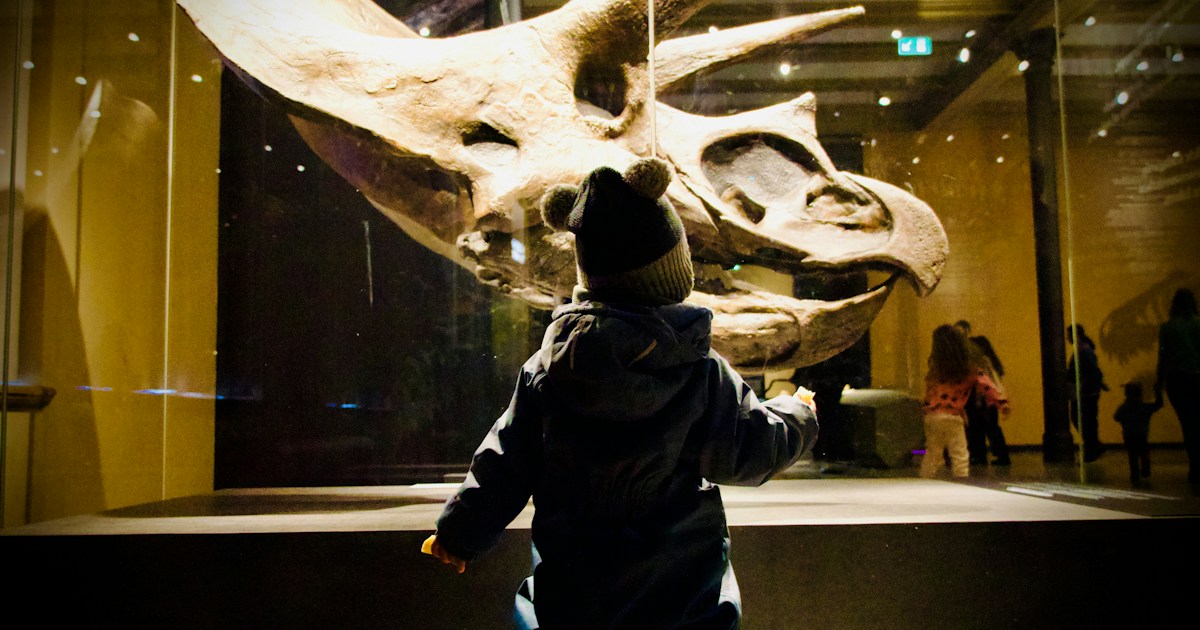
If your child is autistic and currently knows more about dinosaurs than you ever expected to learn in your lifetime, there’s a decent chance you’ve already considered the Natural History Museum.
What you may not know is that NHM has put together some genuinely useful sensory resources.
Visitors can borrow sensory kits containing noise-canceling headphones, a fossil stress ball, sensory guide and fidget cube. The museum also provides a visual checklist, Social Narrative and detailed Sensory Guide to help families plan before arriving.
The Sensory Guide is particularly useful because it doesn’t simply declare the entire museum “sensory friendly.”
It helps families understand that different galleries have different levels of sound, lighting and tactile interaction.
That’s much more realistic.
The Dinosaur Hall, Gem and Mineral Hall, Nature Lab and mammal halls can all feel completely different to the same child.
- Location: 900 Exposition Boulevard, Los Angeles, CA 90007
- Best for: Dinosaur kids, animal kids, rock and mineral kids, and children who become deeply interested in specific subjects.
- Sensory tools: Free sensory kits available first come, first served.
- Preparation tools: Visual Checklist, Social Narrative and Sensory Guide.
- Quiet/reset options: Family Care Lounges are available on Levels 1 and 2. Ask Guest Relations about access.
- Regular hours: Generally 9:30 a.m. to 5:00 p.m., with monthly and holiday closures.
- Bathrooms: Accessible and all-gender restrooms are available throughout the museum.
- Parking: Museum and Exposition Park parking is available for a fee. Event days at USC and the Coliseum can dramatically affect traffic and parking, so check the area calendar.
- Food: Food is available around the museum and Exposition Park.
- What might be challenging: Some exhibits can be loud, dark or visually intense. Dinosaur Encounters uses a large realistic dinosaur puppet and can be frightening or overstimulating for some children.
- Website: https://nhm.org/plan-your-visit/accessibility
Our parent tip: Download the sensory guide before visiting and choose two or three galleries instead of attempting the entire museum. If your child wants to spend 45 minutes looking at minerals and couldn’t care less about anything else, that’s a successful museum visit.
One additional note for schools: NHM currently offers lower-capacity Sensory Friendly Field Trip Days on selected first Mondays during the school year, with reduced sound, adjusted lighting, a Relaxation Zone and sensory kits.
7. The Broad – Sensory Morning
Best for an autistic child who loves art, color, patterns or unusual visual experiences
This may be the surprise pick on the list.
The Broad is not a children’s museum.
That’s precisely why some older autistic kids may love it.
If your child is fascinated by color, repetition, patterns, sculpture, contemporary art or unusual visual environments, The Broad can be a fantastic outing. But we’d specifically look at its Sensory Morning program rather than simply arriving during a crowded weekend.
Sensory Morning is held on the third Sunday of each month from 9:00 to 10:00 a.m., before the museum opens to the general public.
The experience includes smaller crowds, quieter galleries, adjustments to sound and lighting, sensory touch objects, noise-reducing headphones and a Social Narrative families can use before arriving.
Visitors also receive early access to Yayoi Kusama’s Infinity Mirrored Room.
That experience can be extraordinary for a child who loves lights and immersive visual environments.
For a child who is sensitive to darkness, mirrors, confined spaces or intense visual stimulation, it could be exactly the wrong thing.
Again, knowing your child matters more than any “best activities” list.
- Location: 221 S. Grand Avenue, Los Angeles, CA 90012
- Best for: Older elementary children, tweens and teens who enjoy visual art, patterns and unusual spaces.
- Sensory Morning: Third Sunday of each month, currently 9:00 to 10:00 a.m.
- Upcoming 2026 dates: September 20, October 18, November 15 and December 20.
- Cost: Free, but Sensory Morning requires a reservation and capacity is limited.
- Sensory tools: Noise-reducing headphones and sensory touch objects, subject to availability.
- Preparation: Online Social Narrative available.
- Crowds: Significantly reduced during Sensory Morning.
- Parking: Downtown LA parking. There are garages nearby, but this isn’t an outing where we’d arrive five minutes before our reservation.
- Food: Numerous Downtown options are nearby.
- What might be challenging: Art generally cannot be touched. That’s important if your child has difficulty resisting tactile exploration. Certain installations can also involve darkness, mirrors, bright lights or visually intense environments.
- Website: https://www.thebroad.org/events/series/sensory-morning-broad
Our parent tip: Look at photos of the artwork currently on view with your child beforehand. Let them choose two or three pieces they want to find. Turning the museum into a mission can make an abstract art museum feel much more concrete.
AfterschoolSearch is launching soon in Los Angeles County
Get early access to the easiest way to find kids’ activities, sports leagues, classes, camps and events near you. No spam, just launch news and parent guides like this one.
8. ACEing Autism – Burbank
Best for trying an actual sport in an autism-focused environment
Not every activity on this list needs to be a museum or attraction.
ACEing Autism uses tennis to create structured recreational programs specifically for autistic children.
The program is built around the idea that coaches adapt to how each participant learns rather than expecting every child to fit into one teaching style. Visual schedules are used to create structure and predictability, and volunteers receive training in best practices for working with autistic children.
That’s particularly valuable for a child who might enjoy sports but has struggled in a traditional team environment.
There is less pressure to understand an entire game’s social dynamics.
You’re learning a skill.
You’re moving.
You’re working on the court with support.
And tennis gives kids a very clear physical objective: hit the ball.
ACEing Autism currently has a Fall 2026 program at Burbank Tennis Center.
- Location: Burbank Tennis Center, 249 Amherst Drive, Burbank, CA 91504
- Best for: Autistic kids who like movement, balls, racquets, repetitive skill-building or individual sports.
- Ages: Separate groups for ages 5 to 8, 9 to 12 and 13 to 18.
- When: Seasonal sessions, usually on Saturdays (fall 2026 ran from September through October). Check the website for the next session.
- Cost: About $100 per session at the Burbank Tennis Center at last check.
- Scholarships: ACEing Autism offers scholarship options and accepts certain Self-Determination funding.
- Structure: The program uses visual schedules and an established curriculum to make sessions more predictable.
- What might be challenging: It’s outdoors, tennis balls move unpredictably and there will be other participants on nearby courts. A child who strongly dislikes heat, racquet sounds or group instruction may need additional preparation.
- Website: https://aceingautism.org/programs/burbank-ca/
Our parent tip: Don’t worry about whether your child is “athletic.” That’s not the point. If they’ve shown any interest in hitting balls, racquets or repetitive physical activities, it may be worth trying.
ACEing Autism also operates other Southern California programs, so use the organization’s program finder if Burbank isn’t convenient.
9. Regal My Way Matinee – Participating Los Angeles-Area Theaters
Best for the child who wants to see a movie but can’t comfortably sit through a traditional theater experience
Movie theaters come with a surprisingly long list of rules that can be difficult for some autistic children.
Sit still.
Be quiet.
Don’t walk around.
Don’t talk.
And then we put the child in a dark room and turn the movie up extremely loud.
Regal’s My Way Matinee changes that.
These sensory-friendly screenings keep the lights up and the volume down. More importantly, guests are explicitly allowed to move around, talk, sing, cry, dance or vocalize during the movie.
That last part matters.
A sensory-friendly movie isn’t very useful if a parent still spends the entire film worried that somebody is going to complain about their child.
My Way Matinee screenings are typically the first show of the day on select Saturdays each month at participating Regal theaters.
- Locations: Participating Regal theaters. Use Regal’s location finder because participating theaters and films can change.
- Best for: Movie-loving kids who struggle with darkness, loud volume, remaining seated or staying quiet for an entire film.
- Lighting: Brighter than a standard screening.
- Sound: Lower than a standard screening.
- Movement: Allowed.
- Vocalizing: Allowed.
- Crowds: Depends on the film and theater, but everyone attending the screening should understand what kind of environment it is intended to be.
- Food: Standard movie theater concessions.
- What might be challenging: Even with reduced volume, the movie itself can contain sudden sounds, intense scenes, flashing imagery or emotional moments. Preview the film if those are concerns for your child.
- Website: https://www.regmovies.com/promotions/my-way-matinee
Our parent tip: This can be a great first movie-theater experience. If your child lasts 35 minutes and wants to leave, leave. You don’t need to turn finishing the movie into the goal.
10. A Quiet Morning at the Park
Best free option, and sometimes genuinely the best option on this entire list
We’re intentionally making number 10 something that doesn’t require a ticket, reservation or special program.
Go to a park early.
Not every autistic child needs an officially designated autism activity.
For some kids, a familiar playground at 8:00 on a Sunday morning may be dramatically more enjoyable than a sensory-friendly event involving a new building, unfamiliar staff, parking garages, ticket scanners and dozens of transitions.
Los Angeles has some excellent inclusive playgrounds, including Shane’s Inspiration in Griffith Park and Aidan’s Place at Westwood Recreation Center.
But the specific park matters less than understanding why this can work.
Early mornings tend to mean fewer children, less unpredictable movement, easier parking, less waiting for playground equipment and less overall noise.
Your child can explore without being rushed.
You can leave whenever you want.
It costs nothing.
And if the outing lasts 27 minutes, nobody cares.
For families in the Valley, Lake Balboa can also be a good choice for children who prefer walking, watching birds, riding a scooter or simply being outside rather than using playground equipment.
- Best for: Kids who enjoy outdoor movement but find busy playgrounds overwhelming.
- Best time: Usually early morning, before playgrounds become crowded and before the Valley gets hot.
- Cost: Free.
- Noise: Highly dependent on the park and time of day.
- Bathrooms: This varies enormously. Check before going if restroom access is important.
- Food: Bring whatever your child reliably eats.
- What might be challenging: Dogs, lawn equipment, birthday parties, sports games and other children can change the sensory environment unexpectedly.
Website for LA’s universally accessible playgrounds: https://recreation.parks.lacity.gov/uap
Our parent tip: If your child has a favorite park, don’t underestimate the value of familiarity. The “best” playground in Los Angeles isn’t necessarily better than the place where your child already knows where the swings, bathroom and car are.
Sensory-Friendly Schedule at a Glance
| Place | When it happens | Good to know |
|---|---|---|
| We Rock the Spectrum, Tarzana | Open play most days | Built for sensory needs every day, not just special hours |
| Noah’s Ark at the Skirball | Sensory Friendly Fridays | Smaller crowds and adjusted lights and sound |
| Discovery Cube Los Angeles | Third Sunday of the month, 8 to 10 a.m. | Before the museum opens to the public |
| The Broad | Third Sunday of the month, 9 to 10 a.m. | Free with a reservation |
| Aquarium of the Pacific | A few evening events a year | Check the website for the next date |
| Regal My Way Matinee | Select Saturdays, first show of the day | Lights up, sound down, moving around is fine |
| ACEing Autism, Burbank | Seasonal Saturday sessions | Tennis program for ages 5 to 18 |
| Los Angeles Zoo | Any weekday morning | Quietest right after opening |
Schedules change, so confirm dates on each website before you go. Looking for more calm indoor spaces? Many smaller indoor play spaces in LA are quieter on weekday mornings too.
How We’d Choose an Activity for Your Child
The most important thing about this list is that we wouldn’t work our way through it from number one to number ten.
We’d start with your child.
If your child seeks movement and loves crashing, swinging and climbing, try We Rock the Spectrum.
If they’re fascinated by science and want to touch things, try Discovery Cube’s Sensory Friendly Morning.
If animals are their thing and they do well outdoors, try the LA Zoo, but download the Social Story first and don’t attempt to see everything.
If they can stare at fish for an hour, put Aquarium of the Pacific’s Autism Families Night on your calendar.
If dinosaurs have taken over your household, use the Natural History Museum’s sensory resources and build the entire visit around Dinosaur Hall.
If your child loves art, patterns and visual experiences, try The Broad’s Sensory Morning.
If they want to play a sport but traditional leagues haven’t worked, look into ACEing Autism.
If they love movies but conventional theaters don’t work for them, try a My Way Matinee.
And if all of that sounds exhausting today?
Go to the park.
There is nothing inferior about the simpler choice.
A Few Things We’d Do Before Any New Outing
For many families, the activity itself isn’t the hardest part.
It’s everything surrounding it.
Getting dressed. Getting in the car. Parking somewhere unfamiliar. Walking into a new building. Waiting in line. Having a wristband put on. Hearing a hand dryer unexpectedly. Discovering that the chicken nuggets look different from the chicken nuggets at home.
If your child benefits from predictability, prepare for the boring details too.
Look at photos of the entrance together. Show them where you’re going on a map. If the attraction provides a Social Story or visual schedule, use it. Tell them roughly how long you’re staying and what happens afterward.
Bring whatever reliably helps your child regulate. That might be headphones, sunglasses, a fidget, a comfort object, a tablet, a snack, a chewy, a favorite hoodie or something else entirely.
And know your exit.
That sounds negative, but it isn’t.
Knowing that you can leave quickly can make it easier to try something new in the first place.
Don’t Judge the Outing by How Long You Stayed
This may be the most important part of the article.
You drove 45 minutes.
You paid for parking.
You bought admission.
You packed everything.
And 38 minutes later, your child is done.
It’s incredibly tempting to think:
We came all this way. We have to stay longer.
You don’t.
If your child had 30 good minutes somewhere new, that can be a successful outing.
Maybe next time it’s 45.
Maybe they never want to go back.
Maybe they become obsessed with the place and ask to return every weekend for the next three years.
That’s kids.
The point of finding autism-friendly and sensory-friendly activities isn’t to train children to tolerate as many attractions as possible.
It’s to give families more places where going out together feels possible.
One More Thing About the Word “Autism-Friendly”
We use terms like “autism-friendly” and “sensory-friendly” in this guide because they’re useful shorthand for parents trying to find accommodations.
But they can also oversimplify things.
Autistic children aren’t one type of child.
Some speak constantly. Some communicate differently or don’t use spoken language.
Some desperately want social interaction. Others need more space.
Some seek intense sensory experiences. Others avoid them.
Some love surprises.
Some want to know exactly what’s going to happen next.
Some can spend an entire afternoon in a crowded museum and then become overwhelmed because the hand dryer in the bathroom was too loud.
So when a venue calls itself sensory-friendly, don’t interpret that as a guarantee that your child will be comfortable there.
Instead, look at what the venue actually does.
Does it lower the volume?
Reduce attendance?
Provide headphones?
Offer a quiet room?
Allow movement?
Have a Social Story?
Turn down the lights, or turn them up?
Those details tell you much more than the label.
More guides for LA parents: 50+ things to do in LA with kids, best hikes for kids in LA and kid-friendly restaurants in LA.
Frequently Asked Questions
What does “sensory-friendly” mean?
Usually it means a venue has reduced noise, softer lighting, smaller crowds or tools like noise-dampening headphones and quiet spaces, often during specific sessions. It’s useful shorthand, but not a guarantee: every child is different, so check the details and plan for what your child needs.
Which LA attractions have sensory-friendly hours?
Examples include Sensory Friendly Fridays at Noah’s Ark at the Skirball, Sensory Friendly Mornings at Discovery Cube Los Angeles on the third Sunday of each month, Sensory Mornings at The Broad (free with a reservation) and Autism Families Night at the Aquarium of the Pacific. Schedules change, so confirm before you go.
Are there free autism-friendly activities in Los Angeles?
Yes. The Broad’s Sensory Morning is free with a reservation, and a quiet early-morning visit to a neighborhood park costs nothing and is sometimes the best option of all.
How can I prepare my autistic child for a new outing?
Prepare for the small details: look at photos of the entrance, show the route on a map, use a Social Story or visual schedule if the venue offers one, and say roughly how long you’ll stay. Bring whatever helps your child regulate, and know your exit. Leaving early isn’t a failure.
Help Us Find More Great Places for Neurodivergent Kids Around Los Angeles
This is exactly the kind of information we want AfterschoolSearch to become better at collecting.
Not simply whether a place offers “kids activities.”
We want parents to eventually be able to find the details that actually determine whether an activity works for their family.
Does the gymnastics program have experience with autistic children?
Is there a quiet space?
Can a parent stay during class?
How big are the groups?
Does the movie theater offer sensory screenings?
Which swim instructors work well with children who need additional support?
Is there an adaptive sports program five minutes from your house that you’ve somehow never heard about?
Los Angeles has far more resources for autistic and neurodivergent children than most families will ever discover through a single Google search.
Our goal is to make those resources easier to find.
Explore more activities for kids around Los Angeles at AfterschoolSearch.com.
AfterschoolSearch is launching soon in Los Angeles County
Get early access to the easiest way to find kids’ activities, sports leagues, classes, camps and events near you. No spam, just launch news and parent guides like this one.